Showing posts with label Porsche. Show all posts

Friday, 27 January 2017

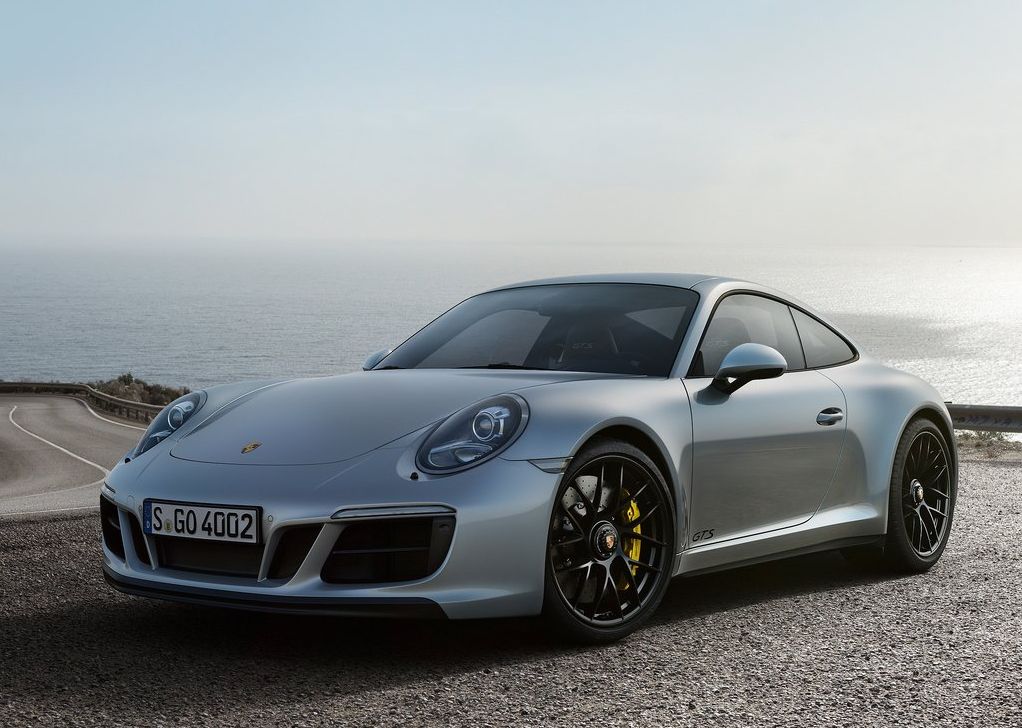
2018 Porsche 911 GTS

 
Porsche has expanded the 911 product line with the GTS models. From March 2017, a total of five variants will be available in Germany: the 911 Carrera GTS with rear-wheel drive, the 911 Carrera 4 GTS with all-wheel drive - both of the above availa-ble as a CoupĂ© and Cabriolet - and the 911 Targa 4 GTS with all-wheel drive. 

A newly developed turbocharger for 3.0-litre six-cylinder flat engine increases power to 331 kW (450 PS). The engine delivers 22 kW (30 hp) more than the 911 Carrera S and 15 kW (20 hp) more than the corresponding GTS prior model with a naturally aspirated engine. All variants are available with a manual seven-gear transmission or optional Porsche Doppelkupplung (PDK).
More power for more performance
The maximum torque of 550 Nm provides even better acceleration and elasticity figures. The torque is available between 2150 and 5000 rpm. Porsche Active Suspension Management (PASM) is included as standard on all GTS models. The GTS Coupés feature the PASM sports chassis, which lowers the body by ten millimetres. The fastest sprinter in the family is the 911 Carrera 4 GTS Coupé: With Porsche Doppelkupplung (PDK) and the Sport Chrono Package as standard, it races from zero to 100 km/h in 3.6 seconds. All GTS models feature a top speed in excess of 300 km/h. The frontrunner at 312 km/h is the Coupé with manual transmission and rear-wheel drive.

Monday, 7 November 2016

2017 Porsche 911 GT3 Cup

 
Boasting a completely redeveloped drive, the Porsche 911 GT3 Cup will take to the starting line on the world's race tracks from 2017. The rear of the world's most-produced GT racing car now houses a 4-litre, six-cylinder flat engine for even more drive. Thanks to thoroughbred motorsport technology, the compact engine with direct fuel injection delivers peak performance of 357 kW (485 hp).

A range of innovative details also improve efficiency in addition to engine performance, ensuring even better durability of the naturally aspirated engine in racing mode and reduced maintenance costs. A valve drive with rigidly mounted rocker arms and a central oil feed is being used for the very first time. What's more, an integrated oil centrifuge is used to optimise oil defoaming in the engine. A crankshaft with significantly increased rigidity has also been installed.

A new front apron and a new rear end improve the downforce of the new Porsche 911 911 GT3 Cup and therefore enhance traction and performance. The prominent 184-centimetre wide rear wing has been retained from the predecessor model. 

Friday, 30 September 2016

2017 Porsche Panamera 4 E-Hybrid

 
The 2016 Paris Motor Show will see Porsche unveil the fourth model in the Panamera line: the Panamera 4 E-Hybrid with controlled all-wheel drive and an electric range of 50 kilometres. The vehicle generates some 340 kW (462 hp) of system power and delivers fuel consumption figures of 2.5 l/100 km in the New European Driving Cycle (NEDC) for plug-in hybrid models. That corresponds to CO2 emissions of 56 g/km. The Panamera 4 E-Hybrid is available to order now, with prices starting at EUR 107,553 including VAT in Germany.

Purely electric range of 50 kilometres
At Porsche, the term "hybrid" is synonymous with not only sustainable mobility, but performance too - a fact proven not least by the victory of the 919 Hybrid in the 24 Hours of Le Mans race in 2015 and 2016. This philosophy is now also defining the Panamera 4 E-Hybrid.

The new Porsche plug-in hybrid always starts in purely electric mode and drives without generating any local emissions within a range of 50 kilometres and a maximum speed of 140 km/h. And yet this Panamera too is a sportscar among the luxury saloons: The all-wheel Porsche achieves a top speed of 278 km/h and delivers a system torque of 700 Nm from stationary without hesitation. The four-door hybrid sports car breaks the 100 km/h barrier in just 4.6 seconds. The torque is transferred to all four wheels and the standard three-chamber air suspension ensures an optimum balance between comfort and dynamism at all times.

Thursday, 22 September 2016

2017 Porsche Macan Turbo with Performance Package

 
As the sports car of the compact SUV segment, the Porsche Macan has been setting standards in terms of driving dynamics since it first made its debut. Now, the renowned Stuttgart sports car manufacturer is upping the ante once again; the enhanced driving dynamics and increased agility of the Macan Turbo with the new Performance Package ensures it stands out at the top of the range.

Courtesy of a performance upgrade, the twin-turbocharged 3.6-litre V6 petrol engine delivers 324 kW (440 hp). With 30 kW (+ 40 hp) more than the Macan Turbo, this horsepower figure places this variant firmly in pole position. The car now accelerates from zero to 62 mph in just 4.4 seconds (- 0.4 seconds), and achieves a new top speed of 169 mph (+ 4 mph). The maximum torque has also risen to 600 Nm (+ 50 Nm) and is available to the driver across a broad rev range of between 1,500 and 4,500 rpm. 

This also increases the tractive force: in Sport Plus mode, the time taken to accelerate from 49 mph to 74 mph has dropped to 2.9 seconds (- 0.2 seconds) and making overtaking especially swift. Depending on the tyres, fuel consumption (in line with the NEDC) is up to 30.1 mpg.

Friday, 1 July 2016

2017 Porsche Panamera

 
The new Porsche Panamera reconciles two contrasting characteristics more than ever before: the performance of a genuine sports car and the comfort of a luxury saloon. It is a Gran Turismo that has been rethought and realigned. The second generation of the Panamera is advancing to become a performance icon of the luxury class.

In this transformation, Porsche has systematically improved the Panamera concept - with a four-door car that has been redeveloped and redesigned down to the last detail. Its engines and transmissions have been redesigned, its chassis perfected, and its display and control concept reinterpreted for the future. The new Panamera also extends the borders between the world of ambitious sports cars and the world of comfortable cruising cars with highlights such as rear axle steering, active roll compensation and three-chamber air suspension.

911 design language with a much more dynamic flyline
Visually, the unique concept of this large Porsche is reflected in a new expressive design: unmistakably a Panamera, unmistakably a sports car - with long, dynamic proportions, pronounced shoulders, athletic flanks and an extremely fast roof line that is 20 mm lower at the rear. This typical Porsche flyline creates a stylistic link to Porsche's design icon, the 911.

Plenty of functionality and easy interaction in the Porsche Advanced Cockpit
The typical Porsche interior has been reinterpreted for the future in the new Panamera. Black panel surfaces and interactive displays combine a clear and intuitive user interface like that of smartphones and tablets with the practical requirements for controlling the car. Classic hard keys and conventional instruments have been reduced significantly. They have been replaced by touch-sensitive panels and individually configurable displays which take centre stage in the new Porsche Advanced Cockpit - with great benefits for the driver as well as the front and rear passengers. Despite a significantly extended range of communication, convenience and assistance systems, different functions can now be used and operated more clearly and intuitively. The Porsche Advanced Cockpit transforms the analogue world into the digital present of mobility, while leaving room for passion. The tachometer, positioned centrally in the instrument cluster, is a tribute to the 1955 Porsche 356 A.

Monday, 25 April 2016

2017 Porsche 718 Cayman

 
The fourth, redeveloped generation of the mid-engine sport coupé has a more striking, athletic and efficient appearance. Just a few weeks after the debut of the new 718 Boxster, the new Porsche 718 Cayman is extending the new model series.
The same new four-cylinder flat engines with turbocharging as in the 718 Boxster are being deployed in the Porsche 718 Cayman. As a result, coupé and roadster have an identical engine output for the first time. The entry-level version is launching in China with an output of 184 kW (250 hp). In the other markets, the 718 Cayman produces 220 kW (300 hp) from two litres of displacement. There are no changes in the S model. Globally, the 718 Cayman S delivers 257 kW (350 hp) with a displacement of 2.5 litres.

The tremendous torque of the new engines in the Porsche 718 Cayman promises driving fun and agility even at low revs. Equipped with the two-litre version of the engine intended for China, the 718 Cayman delivers 310 Nm of torque at speeds ranging from 1,850 rpm to 5,000 rpm. The 220 kW (300 hp) version of the two-litre four-cylinder turbo for all other markets attains a torque of 380 Nm, which is available in a range between 1,950 and 4,500 rpm. The 2.5-litre engine of the 718 Cayman S features a turbocharger with variable turbine geometry (VTG), a technology hitherto used exclusively in the 911 Turbo. 

In the 718 Cayman S, the VTG charger additionally has a wastegate for the first time. It delivers up to 420 Nm (an extra 50 Nm) to the crankshaft at engine speeds ranging from 1,900 to 4,500 rpm. For the driver this means even better torque in all engine speed ranges. The 718 Cayman with PDK and optional Sport Chrono Package sprints from zero to 100 km/h in 4.7 seconds (5.4 seconds in China). The 718 Cayman S completes this sprint in 4.2 seconds. The top speed of the 718 Cayman is 275 km/h (260 km/h in China) while the 718 Cayman S manages 285 km/h.


New chassis tuning for greater precision and more lateral stability
In terms of their driving dynamics, the new Porsche 718 Cayman models follow in the tracks of the classic 718 cars. Thanks to their outstanding agility, the historic mid-engine sports cars won numerous races in the 1950s and 1960s such as the Targa Florio and Le Mans. Lateral rigidity and wheel tracking have been improved in the completely retuned chassis of the 718 Cayman; springs and stabilisers have been designed to be firmer and the tuning of the shock absorbers has been revised. 

Friday, 22 April 2016

2017 Porsche Macan GTS

 
Porsche is enriching the Macan model series by adding an even sportier version. The new Porsche Macan GTS occupies a position between the Macan S and the Macan Turbo. Its mission is to promote the synthesis between sports car and SUV. Its promise is more driving fun combined with exclusivity in design. This means that the Macan is now also following the GTS product strategy that Porsche has been successfully pursuing in other model series for years.

The Porsche Macan GTS is now the tenth offshoot of the GTS family to line up at the start. And as one might expect, it steps up to the mark with enhanced driving dynamics and increased engine power. Its engine is based on the V6 bi-turbo of the Macan S. Thanks to more effective air induction by means of the reworked intake tract and reduced exhaust backpressure together with a boost pressure increased by 0.2 bar to a maximum of 1.2 bar, the three-litre petrol engine now produces an extra 20 hp - 360 instead of 340 hp. At the same time, the maximum torque increases from 460 to 500 Nm at 1450 to 5000 rpm. Power is transmitted via the seven-speed Porsche Doppelkupplung (PDK) fitted as standard. It permits lightning-fast gear shifts without any interruption in traction, automatically or optionally via paddles on the steering wheel.

If it says GTS on the tin, then there must also be more cornering fun inside. Consequently, the Macan GTS impresses with increased driving dynamics. Its handling is even more agile, it steers into corners even more willingly and takes fast alternating bends with increased precision. All in all, the GTS treatment helps the Macan to display a dynamic talent far beyond the conventional SUV standards. Yet even within the Macan series, the GTS establishes itself as the sportiest version. This is achieved through extensive redesigning of the chassis. The Macan GTS sits 15 millimetres closer to the ground than the Macan S and the adaptive damper control of the Porsche Active Suspension Management (PASM) - a standard feature here - has an even sportier setting.

Porsche Macan - the sports car among SUVs
Of course, the chassis with optional air suspension also matches the essence of the GTS. In the normal state, the lowering of the chassis is ten millimetres, with ground clearance continuing to vary according to the driving situation.

Tuesday, 29 March 2016

2017 Porsche 911 R

 
With its new Porsche 911 R, Porsche unveiled a puristic sports car in classical design at the 2016 Geneva International Motor Show. Its 368 kW (500 hp) four-litre naturally aspirated flat engine and six-speed manual sports transmission places the 911 R firmly in the tradition of its historic role model: a road-homologated racing car from 1967. Produced as part of a limited production series, the Porsche 911 R (R for Racing) performed in rallies, in the Targa Florio and in world record runs.

Like its legendary predecessor, the new Porsche 911 R relies on systematic lightweight construction, maximum performance and an unfiltered driving experience: this special limited-edition model of 991 units has an overall weight of 1,370 kilograms and is currently the lightest version of the 911. With the high-revving six-cylinder naturally aspirated engine and manual sports transmission, Porsche is once again displaying its commitment to especially emotional high-performance sports cars. Developed in the motorsport workshop, the 911 R extends the spectrum of high-performance naturally aspirated engines alongside the motor racing models 911 GT3 and 911 GT3 RS.

At work in the rear of the Porsche 911 R is the six-cylinder flat engine with a displacement of four litres, familiar from the 911 GT3 RS. The racing engine delivers 500 hp at 8,500 rpm and generates 460 Nm at a speed of 6,250 rpm. From a standing start, the rear-engined car breaks through the 100 km/h barrier in 3.8 seconds. In keeping with the puristic character of the vehicle, the 911 with its lightweight design is available exclusively with a six-speed sports transmission. Short gearshift travel underlines the active driving experience. The forward thrust of the 911 R continues to a speed of 323 km/h. Combined fuel consumption in the NEDC is 13.3 l/100 km.

A thoroughbred driving machine: technology from the race track
The Porsche 911 R could almost have been made for tight corners. The specially tuned standard rear-axle steering guarantees especially direct turn-in characteristics and precise handling while maintaining high stability. The mechanical rear differential lock builds up maximum traction. Ensuring the greatest possible deceleration is the Porsche Ceramic Composite Brake (PCCB) as a standard feature. It measures a generous 410 millimetres on the front axle and 390 millimetres on the rear. Ultra High Performance Tyres of size 245 millimetres at the front and 305 millimetres at the rear are responsible for contact to the road. They are mounted on forged 20-inch lightweight wheels with central lock in matt aluminium.